Origami tessellations: Miura-ori
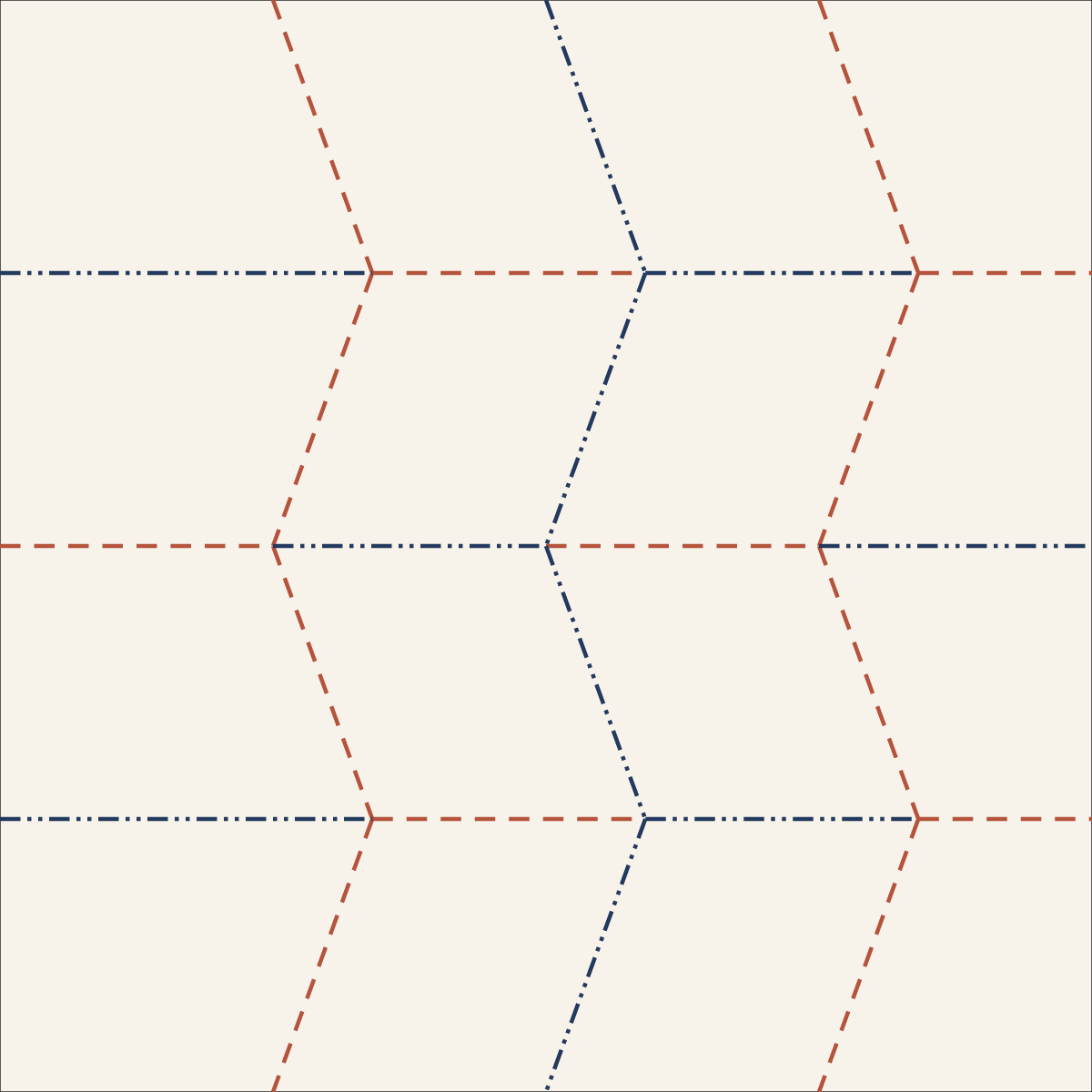
Crease patterns for folded tessellations: one sheet, a grid of repeating folds, and a surface that collapses or twists into shape.
About these patterns
Every crease pattern here folds flat at each point where creases meet: mountains and valleys differ by two there (Maekawa's theorem), and alternate angles around it add up to 180° (Kawasaki's theorem). The site's tests check both at every point, for every pattern, angle and grid.
Sources
- Koryo Miura, Method of Packaging and Deployment of Large Membranes in Space, The Institute of Space and Astronautical Science Report 618, 1985. The Miura-ori crease pattern and how its parallelograms fold, from Miura's paper on folding large membranes for space.
- Yoshimaru Yoshimura, On the Mechanism of Buckling of a Circular Cylindrical Shell Under Axial Compression, NACA Technical Memorandum 1390, 1955. The Yoshimura crease pattern: the diamonds a cylinder buckles into under axial compression, which his paper describes.
- Johnna Farnham, Thomas C. Hull and Aubrey Rumbolt, Rigid folding equations of degree-6 origami vertices, Proceedings of the Royal Society A 478, 2022. The waterbomb tessellation's six-crease points, each a waterbomb base or its flipped form, follow the vertices this paper studies.
- Robert J. Lang, Twists, Tilings, and Tessellations: Mathematical Methods for Geometric Origami, CRC Press, 2018. The square twist tessellation: twists joined by pleats, with neighbors turning opposite ways.
- Thomas C. Hull, Origametry: Mathematical Methods in Paper Folding, Cambridge University Press, 2020. Maekawa's and Kawasaki's theorems, which every tessellation crease pattern here is tested against at each point where creases meet.