Lettering: Tapestry crochet
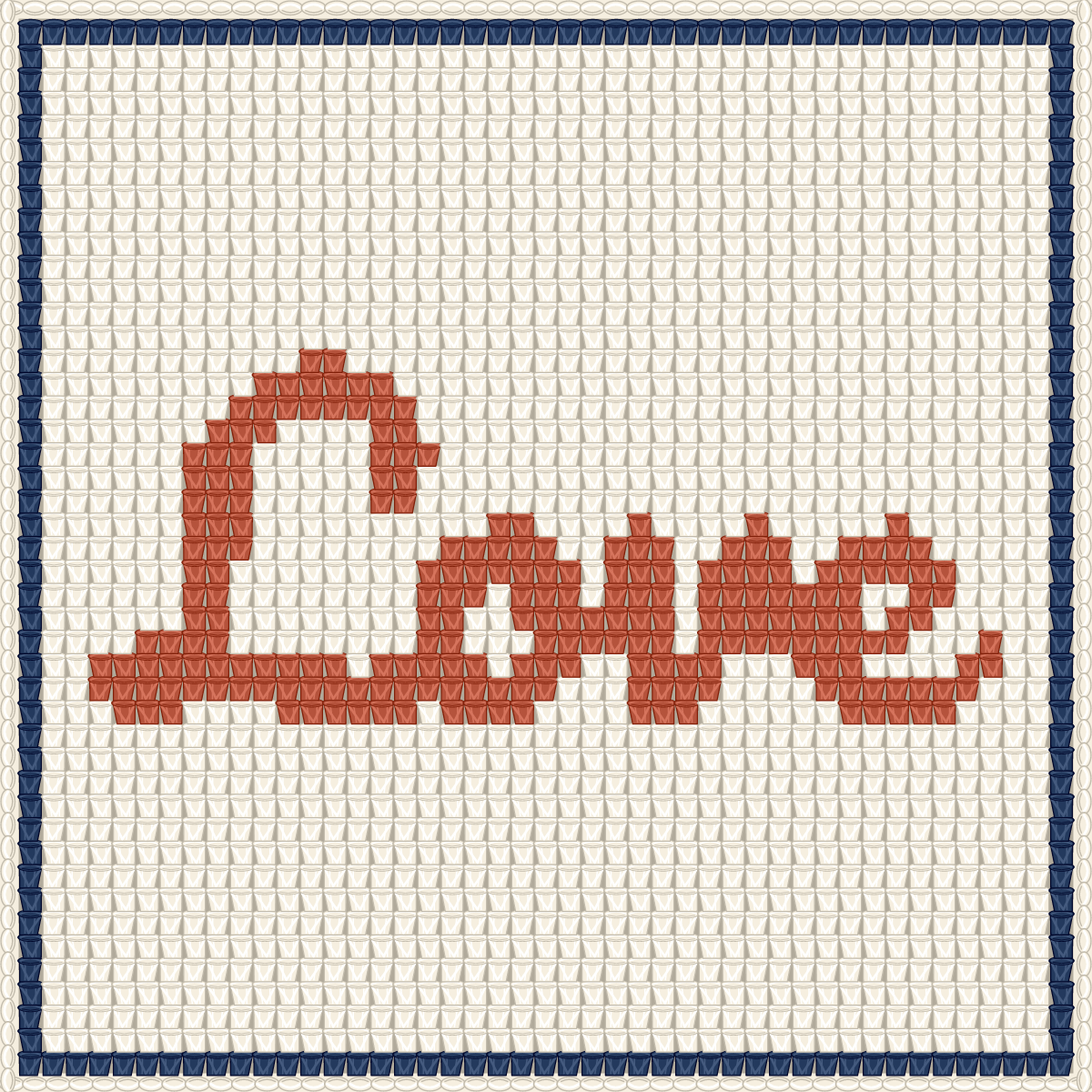
Type a name, an initial or a whole phrase, choose a typeface and colors, then choose how you'll make it. Every row, diagonal or quilt piece is counted for you.
Single crochet worked in rows, carrying the colors you aren't using inside the stitches. Firm, reversible-looking fabric with crisp letters, good for pillows, bags and wall hangings.
Setting the type…
Multi-color squares: tapestry, corner-to-corner and granny
Sources
- Vernon Adams, Jacques Le Bailly and Manvel Shmavonyan, Nunito, SIL Open Font License 1.1. A typeface for lettering charts (rounded bold), drawn as outlines and turned into stitches on the server.
- Andrew Paglinawan, Quicksand, SIL Open Font License 1.1. A typeface for lettering charts (thin), drawn as outlines and turned into stitches on the server.
- JM Solé, Alfa Slab One, SIL Open Font License 1.1. A typeface for lettering charts (heavy slab), drawn as outlines and turned into stitches on the server.
- Claus Eggers Sørensen, Playfair Display, SIL Open Font License 1.1. A typeface for lettering charts (elegant serif), drawn as outlines and turned into stitches on the server.
- Vernon Adams, Jacques Le Bailly, Botjo Nikoltchev and Ani Petrova, Pacifico, SIL Open Font License 1.1. A typeface for lettering charts (script), drawn as outlines and turned into stitches on the server.
- Natanael Gama, Cinzel Decorative, SIL Open Font License 1.1. A typeface for lettering charts (decorative capitals), drawn as outlines and turned into stitches on the server.
- A Crocheted Simplicity, How to Corner-to-Corner Crochet (C2C Crochet): Beyond the Basics. The rule for corner-to-corner rectangles: through the middle, each diagonal grows at one edge and shrinks at the other, so its block count stays the same.