Kaleidoscopes: Two mirrors
Choose a set of mirrors, drop beads, glass or one of this site's patterns into the cell, and turn it. Three- and four-mirror cells repeat without end.
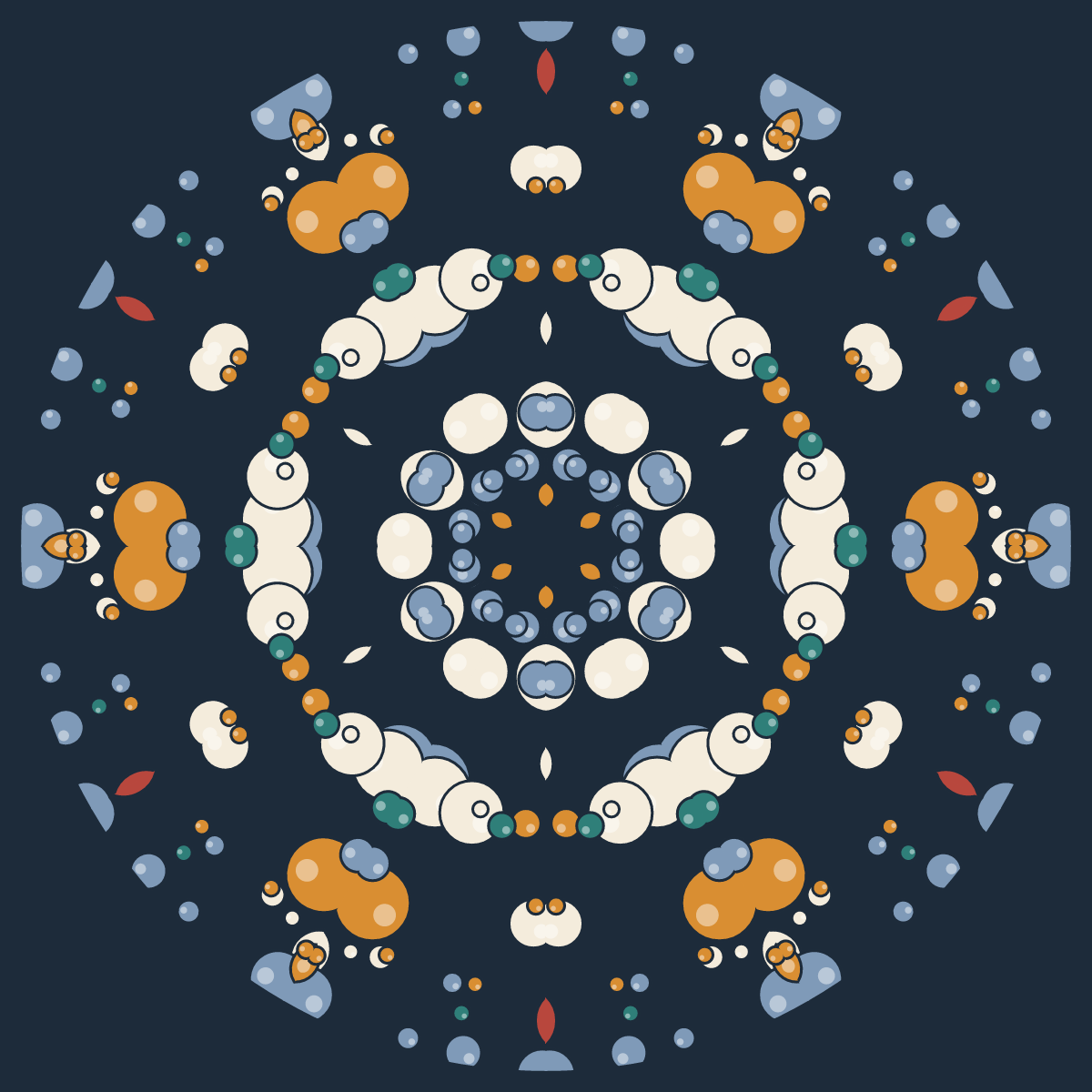
The whole picture, as the mirrors show it.
Sources
- David Brewster, A Treatise on the Kaleidoscope, Archibald Constable & Co., Edinburgh, 1819. Brewster named and patented the kaleidoscope; his mirror angles, which must divide a half turn evenly, set the systems in the kaleidoscope maker.
- H. S. M. Coxeter, Discrete Groups Generated by Reflections, Annals of Mathematics 35, 1934. Why only the 60-60-60, 45-45-90 and 30-60-90 triangles and the square reflect into a pattern that never ends: the mirror cells the kaleidoscope maker offers for seamless repeats.