Weaving drafts: Herringbone
Choose a weave structure and its colors, and get the full draft a weaver reads at the loom: threading, tie-up, treadling and the cloth they make. Every picture repeats seamlessly.
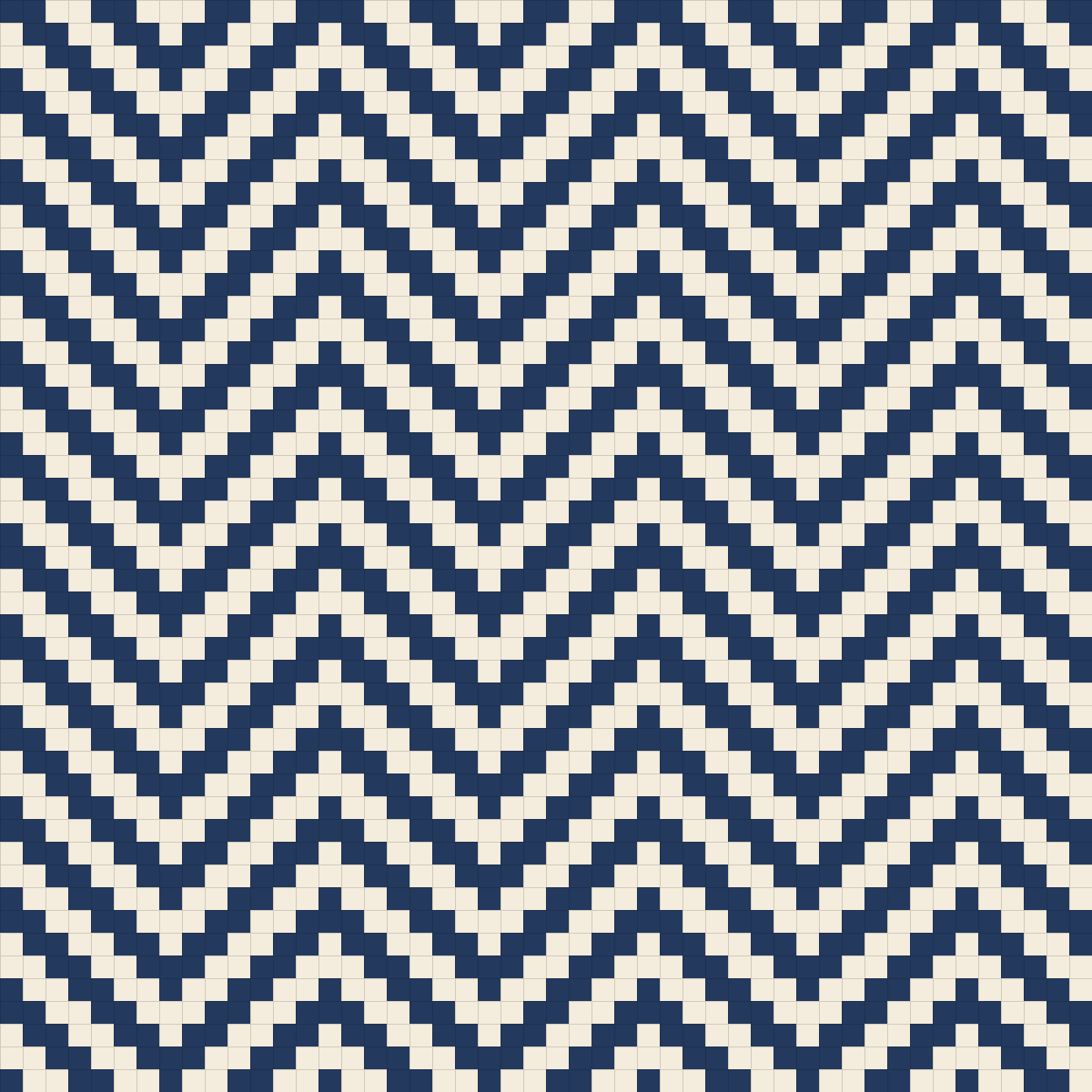
Reading the draft. The threading runs across the top, with shaft 1 in the row nearest the cloth. The tie-up sits at the top right; a filled square is a shaft that rises, as on a jack loom, so on a sinking-shed loom tie the empty squares. The treadling runs down the right, pick 1 at the top. In the drawdown, a square shows the warp where its shaft is raised and the weft where it isn't.
Traditional drafts
Start from a classic: each opens in the builder with its threading, treadling and colors, ready to change.





Sources
- G. H. Oelsner, A Handbook of Weaves, Translated by Samuel S. Dale, Macmillan, 1915. The weave structures in the weaving drafter, from plain weave, twills and satins to basket, rib and huckaback weaves, and the crowfoot, Oxford and warp rib drafts. The drafts are drawn for this site from those structures.
- William Watson, Textile Design and Colour, Second edition, Longmans, Green and Co., 1921. Color-and-weave effects such as houndstooth, hairline and log cabin, which the weaving drafter's color presets build from plain weave and twill.
- J. and R. Bronson, The Domestic Manufacturer's Assistant, and Family Directory, in the Arts of Weaving and Dyeing, Utica, 1817. The spot lace weave that carries the Bronsons' name, behind the Bronson lace draft in the weaving drafter.